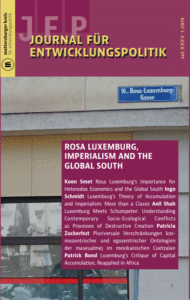
The working class revolutionary leader and socialist theorist Rosa Luxemburg greatly contributed to the understanding of imperialism at the beginning of the 20th century. In The Accumulation of Capital (1913), she advanced Marx‘s critique of political economy and concluded that capitalism relies on the continuous subjection of non-capitalist strata. She did not regard violence, force and exploitation as pre-capitalist residues or deviations, but rather as an integral part of capitalism. Her analysis proves highly insightful and still constitutes a major contribution to Marxist theory. A century after her assassination, this special issue critically explores her original thoughts. The articles in this special issue show that, based on Luxemburg‘s works, it is possible to obtain a nuanced understanding of the Keynesian and neoliberal phases of capitalist expansion, the conflictual relationship between capital and nature, and contemporary socio-ecological conflicts.